
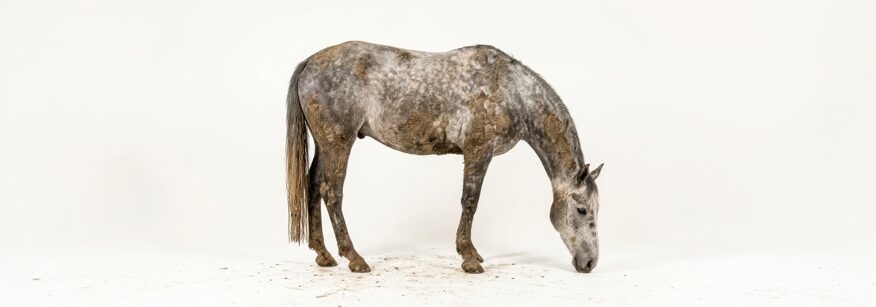
Most of us don’t pick our barns the way we’d pick them if money and time were unlimited. We pick the one with the right trainer, the one we can afford, the one that’s twenty minutes from home instead of forty-five. Turnout availability rarely makes the shortlist when you’re also weighing board rates and arena footing.
This isn’t an article designed to make you feel guilty about where your horse lives. But it is an article about what the research actually says, because the equestrian industry has been slow to reckon with findings that other horse cultures, particularly in Europe and the UK, have taken seriously for decades.
What Horses Are Actually Built to Do
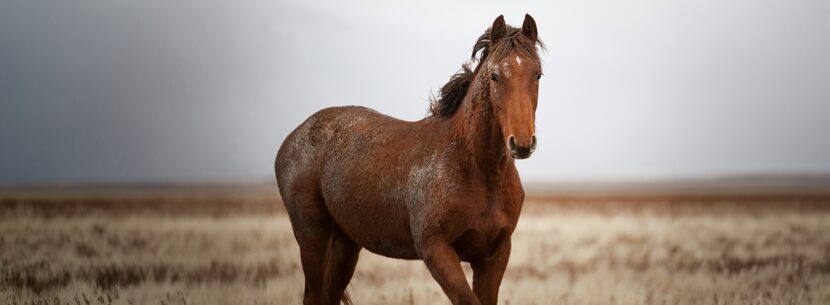
Feral horses cover between 10 and 16 miles a day. Not in organized work. Just walking, grazing, and moving from one patch of forage to the next, nearly without stopping. Research on feral horse populations in the American West consistently shows this pattern: near-constant, low-level movement, with horses grazing for up to 16 hours out of 24.
(Berger, J. Wild Horses of the Great Basin. University of Chicago Press, 1986.)
The average stabled performance horse gets two to four hours outside his stall each day. Sometimes less. Everything about a horse’s health, from his gut to his lungs to his brain, evolved around that movement. When we take it away, things go wrong. The research is fairly consistent about what that looks like.
The Gut
A horse’s stomach produces acid continuously, whether he’s eating or not. The natural buffer for that acid is saliva, which is produced through chewing. A horse grazing freely produces enough saliva to keep his stomach reasonably buffered. A horse standing in a stall waiting for his morning feed does not.
The result: studies have found gastric ulcers in 60 to 90 percent of performance horses, depending on discipline and management. Racehorses and sport horses in full training are at the highest end of that range. Horses with consistent access to pasture and free-choice forage show significantly lower prevalence. (Andrews FM, et al. Equine Veterinary Journal, 2005.)
Colic follows similar logic. A moving horse keeps his gut moving. A stationary horse doesn’t. Impaction colic, one of the most common types in domestic horses, occurs when gut contents slow down and dry out. A prospective study following over 1,000 horses found stabling significantly increased colic risk compared to horses kept on pasture. (Tinker MK, White NA, Lessard P, et al. “Prospective study of equine colic incidence and mortality.” Equine Veterinary Journal. 1997;29(6):448-453.)
The Lungs
Even a well-managed stall has dust. It has ammonia from urine, particles from hay and bedding, and limited fresh air circulation. Horses breathe all of this, all day and all night.
Over time, this adds up. Inflammatory airway disease, sometimes called equine asthma in its more severe form, is strongly associated with time spent in enclosed stabling. A consensus statement representing the current standard of care on this issue found that environmental management, specifically reducing dust and ammonia exposure, is the single most important treatment factor. (Couëtil LL, Cardwell JM, Gerber V, et al. “Inflammatory Airway Disease of Horses: Revised Consensus Statement.” Journal of Veterinary Internal Medicine. 2016;30(2):503-515.) Horses with consistent outdoor access have meaningfully lower rates of respiratory inflammation.
The Mind
This is where some readers will push back, so let’s be direct about it.
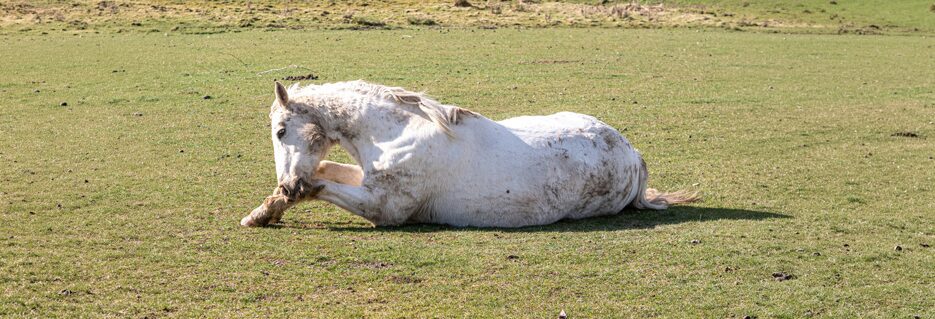
Cribbing, weaving, stall walking, wood chewing: these are called stereotypies, meaning repetitive behaviors that serve no clear function. For a long time the horse world treated them as vices or bad habits picked up from barn mates. The research says something different.
A study published in Equine Veterinary Journal found that stereotypies were strongly associated with management factors including stall confinement, high concentrate feeding, and limited forage access. These behaviors don’t develop in horses who live primarily outside. They develop in horses who have no other way to cope with an environment that doesn’t allow them to meet their basic behavioral needs. (McGreevy PD, Cripps PJ, French NP, Green LE, Nicol CJ. “Management factors associated with stereotypic and redirected behaviour in the Thoroughbred horse.” Equine Veterinary Journal. 1995;27(2):86-91.)
Research measuring cortisol levels, the body’s primary stress hormone, in stalled versus pastured horses consistently finds higher stress markers in horses with limited turnout and limited social contact. (Rivera E, Benjamin S, Nielsen B, Shelle J, Zanella AJ. “Behavioral and physiological responses of horses to initial training: the comparison between pastured versus stalled horses.” Applied Animal Behaviour Science. 2002;78(2-4):235-252.)
The Injury Argument
Yes, horses get hurt in turnout. This is true.
They also get cast in stalls, develop laminitis worsened by inactivity, and bow tendons standing still. The more useful question is whether the cumulative health costs of confinement outweigh the risks of movement. For most horses, the evidence says yes.
Research on young horses found that group housing with regular movement produced better behavioral outcomes and lower stress during training than stall housing. (Søndergaard E, Ladewig J. “Group housing exerts a positive effect on the behaviour of young horses during training.” Applied Animal Behaviour Science. 2004;87(1-2):105-118.) Movement on varied terrain, including uneven or soft footing, builds the small muscles and proprioceptive responses that flat arena work doesn’t fully replicate.
What You Can Actually Do
We are not going to pretend everyone reading this can call their barn manager tomorrow and demand different housing arrangements. Boarding is a negotiation, and most of us are not in a position to dictate management practices.
But you can ask specific questions about turnout when evaluating a new barn. You can advocate for free-choice hay in your horse’s stall, which addresses the acid buffering problem even when outdoor time is limited. You can pay attention to your horse’s behavior over time, because stereotypies and changes in temperament are information.
And you can push back, gently, on the assumption that more stall time means more safety. The science has moved. A lot of barn management hasn’t.
The mud washes off. The rest of it is harder to undo.

BLAIR BUSH is the founder and editor-in-chief of Modern Amateur Magazine. A lifelong horse person with a roundabout path to get here, she grew up riding gaited horses, stepped away from the sport for nearly two decades and returned at 33 with a switch to English riding. A brief detour through the hunter ring eventually led her to eventing, where she found her people. She is currently focused on dressage and working toward her USDF Bronze Medal—which, she will tell you, is a five-year plan and not a suggestion. She is based in Atlanta, Georgia.

