
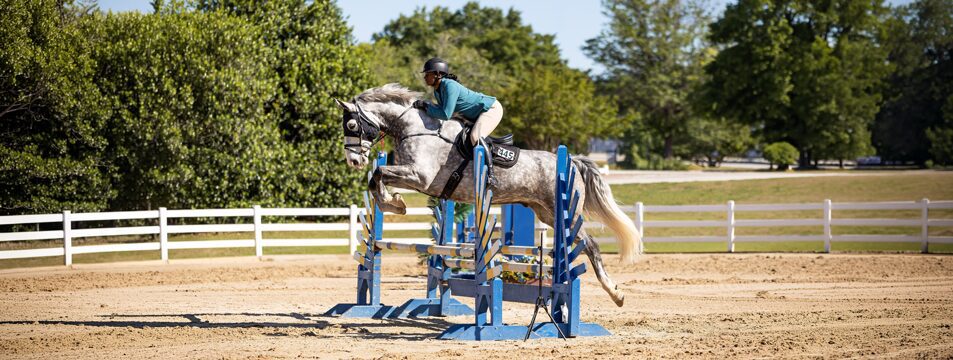
Adult amateur eventer Aria Bachan on the horse who challenged her, the trainer who pushed her, and refusing to accept that she didn’t belong.
Before Aria Bachan was an adult amateur eventer, she was a ten-year-old with a golf cart.
She would drive it up to the fence line at the Chateau Elan hunter-jumper shows and watch the riders compete—the horses, the courses, the whole particular world of it. She remembers thinking, very clearly: I want to do that.
Her grandma helped her find a barn. The first one wasn’t right. The second one was, and she stayed there for thirteen years.
That is the origin story of most adult amateurs, in one way or another. Someone or something we watched. A thing we decided we wanted. A slow, uneven path toward getting there. What separates Aria’s story from the version most riders tell isn’t the the golf cart. It’s what happened after she got in the saddle: at almost every lesson, every horse show, every clinic, she was the only Black rider in the room.
“At first, it was intimidating,” she said. “You become very aware of the fact that you don’t look like everyone else, and it’s easy to wonder if you truly belong.” That wondering is the piece that most equestrians never have to do. It’s also the piece that shapes everything that came after.
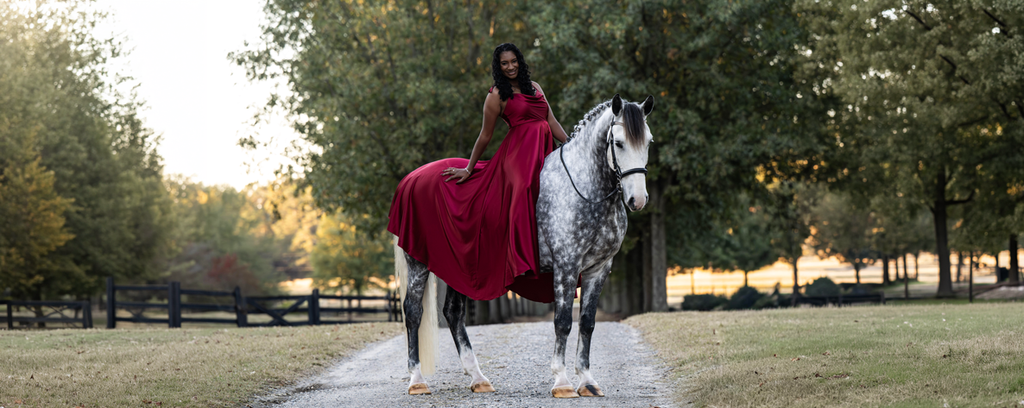
ON BELONGING
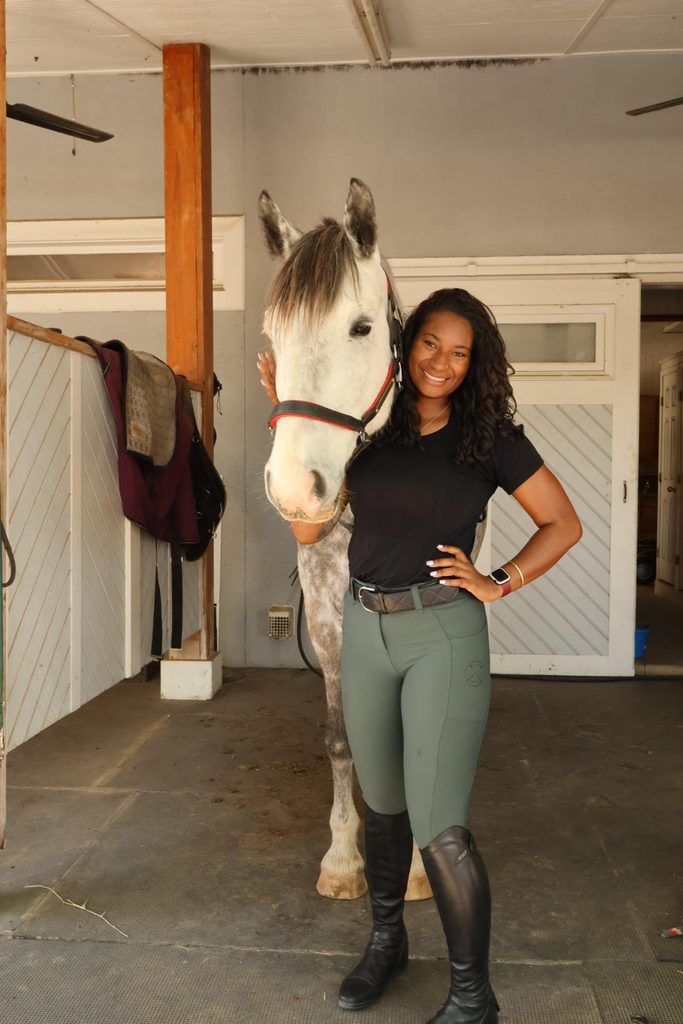
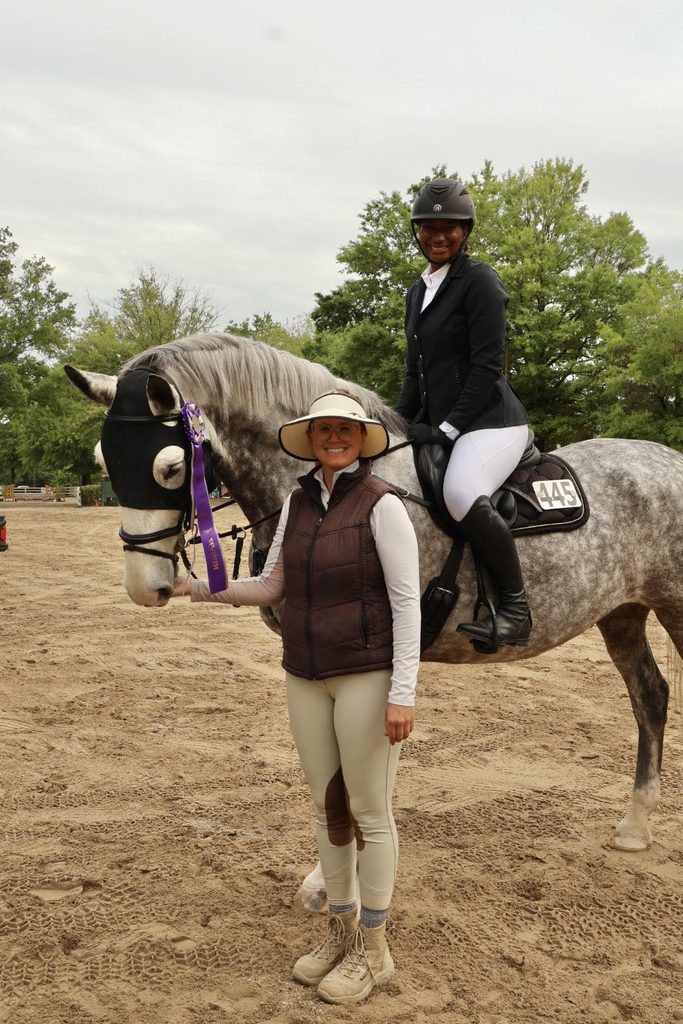
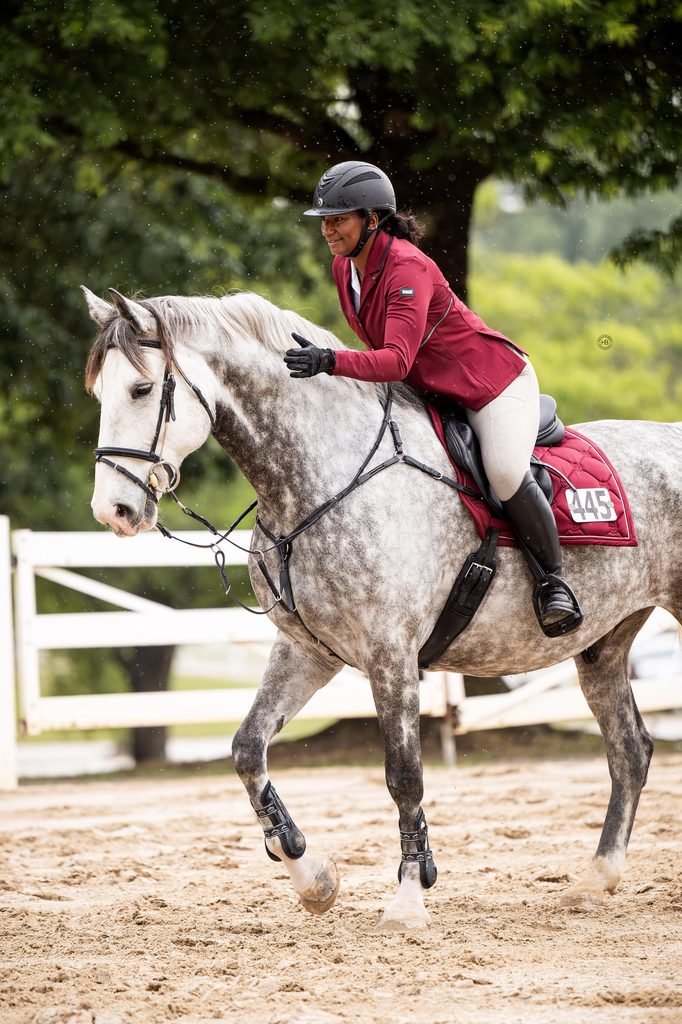
Aria is now an adult amateur eventer based in the Southeast, working a full-time job as a health benefits analyst at a consulting firm and riding a big gray horse named Everest under the guidance of her trainer, Eden Miller. She started with RIFNA equitation-style shows as a kid, moved into combined training, and eventually landed in eventing at her current barn, drawn to the discipline precisely because it scared her.
She still notices, walking into most horse shows, that she is often the only Black rider in the ring. What has changed is what she does with the noticing.
“I no longer see being the only one in the ring as something that sets me apart in a negative way,” she said. “Instead, I see it as an opportunity. If someone sees me competing and realizes, there’s someone who looks like me doing this, then maybe they’ll believe they can do it too.”
She carefully draws a distinction: representation is not the same thing as belonging. Representation is being visible. Belonging is being welcomed. And the equestrian industry, from her perspective, has been much better at the first than the second.
“The conversation often stops at representation instead of continuing into belonging,” she said. “It’s wonderful to celebrate diversity, but it shouldn’t only happen during a campaign or a designated month. Inclusion is something that should be reflected in the everyday stories we tell, the athletes we highlight, the brands we partner with, and the opportunities we create.”
Success isn’t always about having a flawless performance.
She also pushes back on the reduction that happens when representation becomes a single story. “Black equestrians aren’t a monolith. We all come from different backgrounds, disciplines, and experiences, and those stories deserve to be told in an authentic way rather than being reduced to a single narrative.”
The moment that most crystallizes why she keeps sharing her journey happened at HJ Fox (a local show series in the north Atlanta suburbs), when the mother of a young rider approached her ringside. Her daughter, the woman said, looked up to Aria. Seeing Aria’s journey meant something to her.
“Knowing that another young Black rider can see herself belonging in this sport means more to me than any ribbon,” Aria said.
This is her point about belonging, in practice. It doesn’t look like a campaign. It looks like a mother walking up to a stranger at a horse show and saying: my daughter sees you.
MEET EVEREST
She swore she would never own a gray. The first horse she ever showed was gray, and she was done with it after that. Then Everest came along.
He is a Dutch Harness Horse/Percheron cross—big, powerful, and impossible to miss. He is also gray. Dapple gray, specifically, the kind that photographs like a fairy tale and, presumably, still requires a lot of shampoo.
Aria didn’t know he was the one on the day she got him. If anything, she questioned whether she had made the right decision.
“Everest is a big Dutch Harness Horse/Percheron cross with an even bigger personality,” she said, “and I quickly realized he wasn’t going to be the straightforward, push-button horse I was used to riding.”
But there was something about him that kept pulling her in. Curious. Expressive. Intelligent. In the pasture, he is playful and always aware of what is happening around him. When he locks onto a jump, his whole expression changes: ears forward, focus sharpening, the power and determination gathering underneath him before he even leaves the ground.
He also has opinions, and he isn’t afraid to share them. He is sensitive enough that he can’t be strong-armed into anything. He responds to patience, to clarity, to a rider who is willing to communicate rather than command.
He is, in other words, exactly the wrong horse for someone looking to take the easy path. He is also the horse who has taught Aria, again and again, that the best partnerships aren’t the ones that arrive fully formed. They are the ones that get built. The ones where the horse gives you his best because you’ve given him yours.
“Like any rider, I’ve made my share of mistakes,” she said—wrong distances, getting left behind, not giving him the perfect ride. “Time after time, Everest has been incredibly forgiving. Instead of making me pay for those mistakes, he tries his heart out to get us to the other side of the fence safely.”
Her trainer’s trainer, Gerhard Ablinger, once told her that a horse like Everest—not a schoolmaster, but with drive and heart and a real opinion about the world—is the kind of horse who can take a rider through a 4-foot-9 triple combination.
“That meant so much,” she said, “because it reminded me that Everest’s opinions aren’t a weakness. They’re part of what makes him special.”
THE RAINY STARTER
Her first real cross-country experience was a Starter course at a schooling show, on a day when the sky refused to cooperate.
It had been raining. The ground was slippery. Aria stood in the start box thinking, what did I sign up for?
She was nervous, and she was excited, and the two feelings were doing exactly what they always do at the start box: refusing to sort themselves out.
She and Everest were still learning to trust each other on course. They stopped at almost every fence. Every stop, they regrouped. Took a breath. Tried again. Every stop, they kept going.
By the end of the course, they had jumped every fence. And somehow—the part Aria still finds funny—they finished with no penalties.
“It wasn’t a perfect round by any means,” she said, “but it was one of the most valuable rides I’ve ever had. It taught me that success isn’t always about having a flawless performance. Sometimes it’s about staying determined, working through the challenges, and finishing what you started.”
When she crossed the finish line, she wasn’t proud because they had nailed it. She was proud because they had faced something that scared them and finished it anyway.
That is what cross-country actually looks like from the inside. Not fearless. Not smooth. Not the version that gets edited into a highlight reel on Instagram. Real cross-country is the version where you get to the other side of the fence because you decided you could.
THE REFUSAL
Ask Aria what her real turning point was as a rider, and she won’t tell you about a jump; she will tell you about a dressage arena.
From the beginning, she was told that dressage was going to be their weakest phase. Everest wants to move forward. He is opinionated. He can be defensive. Developing the strength and patience dressage requires wasn’t going to happen overnight, and it might not happen at all in the way it does for a purpose-bred warmblood.
She could have accepted that ceiling. Plenty of riders do. Instead, it made her stubborn.
“I’m determined to prove that with time, consistency, and the right training, Everest can become a good dressage horse,” she said. “Maybe he’ll never move like a purpose-bred warmblood, but I know he’s capable of so muchmore than people expect.”
Every improvement, no matter how small, feels earned to her. Every marginally better score. Every marginally more connected ride. She sees them all as evidence—not that they’ll get to the top of the sport, but that they are allowed to keep climbing.
This is the sentence in her story that reveals who she actually is: “I refused to give up on that goal.”
A REAL WEEK
The balancing act is real, and Aria is honest about it in the way most adult amateurs learn to be honest about it eventually.
She works a full-time desk job. She is up at 5 a.m. on office days. Between the commute, the traffic, and the sheer exhaustion of a day at a screen, Tuesdays aren’t a barn day for her.
Most days, though, she logs off and heads straight to Everest. Lesson, flat ride, jump school, groundwork—it depends on the day. It depends on the horse. Some days she questions how she is fitting it all in.
Then she pulls into the barn.
“The stress of the day melts away,” she said. “Horses have become my escape and my reset.”
That is a sentence most adult amateurs have thought and never said out loud. Aria says it out loud. That, too, is a small piece of the belonging she is building for other people who need to hear it.
WHAT SHE WANTS YOU TO KNOW
If you are reading this and wondering whether you belong in this sport, Aria has an answer for you.
“I want them to know that they belong before they ever feel like they do,” she said. “So many people look around this sport and convince themselves they don’t fit the image of what an equestrian is supposed to be. Maybe they feel too old, too young, too tall, too short, too big, too small, or like they don’t have the same opportunities or background as the people around them. But the truth is, there is no one definition of what a rider looks like.”
Your age. Your height. Your gender. Your size. Your background. None of it determines whether you belong. What determines it is showing up. The willingness to keep learning. To keep chasing what makes you happy. To take up space that you already deserve to take.
“Belonging comes from showing up,” Aria said, “and allowing yourself to take up space.”

BLAIR BUSH is the founder and editor-in-chief of Modern Amateur Magazine. A lifelong horse person with a roundabout path to get here, she grew up riding gaited horses, stepped away from the sport for nearly two decades and returned at 33 with a switch to English riding. A brief detour through the hunter ring eventually led her to eventing, where she found her people. She is currently focused on dressage and working toward her USDF Bronze Medal—which, she will tell you, is a five-year plan and not a suggestion. She is based in Atlanta, Georgia.

