
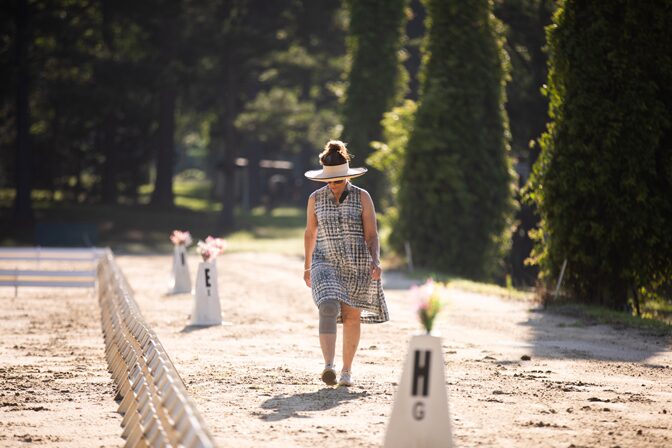
The comment that started this magazine came from someone I know the way a lot of us know each other in this community: through Facebook, through shared circles, through the particular shorthand of people who love the same thing. She has nine horses, a USDF Bronze Medal, multiple national titles, and more years in the saddle than most of us have been paying attention to this sport.
“I’m envious of people that board and show myself,” Megan wrote, “and I have a farm with 9 horses. But I just don’t have time to keep them in shape.”
I sat with that for a long time. Here was someone who has everything the rest of us are working toward and she was describing the same gap we all feel. The distance between loving this sport and being able to fully live in it. If she felt it, we all feel it. And if we all feel it, nobody was talking about it honestly enough. This article is an attempt to fix that.
The Part Nobody Says Out Loud
The equestrian world has a story it tells about itself: that if you want it badly enough, you’ll find a way. Work hard enough, sacrifice enough, want it enough, and the horses will come. What that story leaves out is the part where the infrastructure is quietly collapsing under the weight of its own costs, and the people who love this sport most are the ones left standing outside looking in.
The barn owner perspective is one most riders never hear. The economics of running a lesson program in 2026 — the insurance, the liability, the cost of safe schooling horses that now run what a show horse used to cost, the barn help that is nearly…(continued)
impossible to find and impossible to keep — have made accessibility a luxury that many farms simply cannot afford to offer. The barn rat programs that used to bring kids in off the street in exchange for stall mucking and sponge baths have been swallowed whole by liability concerns and an increasingly litigious culture. The programs that remain are expensive because they have to be. Not out of greed…out of survival.
This isn’t an excuse for the cost of this sport. It’s context. Understanding why access has narrowed doesn’t mean accepting that it should stay that way…and it doesn’t mean there’s nothing you can do about it.
Solving For A Persistent Problem
Megan’s comment didn’t just diagnose the problem. It offered something rarer: a genuine, specific, insider’s map of the territory most people never think to explore.
“Stop looking at only show barns,” she said, “and you will find more options. Showing is just a TINY slice of the horse world but yes, it gets featured a LOT on social media.”
That got me thinking about the highlight reels that we show to each other on social media. The equestrian world that exists on Instagram (the glossy arenas, the immaculate facilities, the perfectly turned out horses going around a hunter course) is a sliver of what’s actually out there. It’s the visible sliver, the photogenic sliver, the sliver that gets shared and liked and aspired to…but it is not the whole picture, and chasing it exclusively means missing most of what makes this sport worth loving in the first place. Instead of focusing on perfectly manicured show rings (and the outfits that come with them), here are some other ways to find joy alongside our equine partners:
Rescue and rehabilitation work. Horse rescues often need experienced riders for light hacking and evaluation rides, and they almost always need ground handlers, fence fixers, water bucket haulers, and people who will simply show up consistently. The horses need the contact. The organizations need the help. The work is meaningful in a way that a schooling show ribbon rarely is.
Small breeders with youngsters. A breeder with a crop of two and three year olds who need ground work, longeing, and light hacking is a person who needs exactly what you have: time, patience, and horse experience. These relationships are usually informal, built on trust, and often evolve into something more — a regular ride, a lease, a connection that lasts for years.
Farms with senior horses. Older horses that need to stay in a light work program are everywhere, and their owners — often people who have been in this sport for decades and are no longer able to ride as much as they’d like — are frequently looking for someone careful and experienced to help. These horses have usually seen everything. They are, in many cases, the best teachers you will ever sit on.
Groundwork and in-hand work. Megan made a point that deserves its own paragraph: there is almost nothing you can do under saddle that you cannot do on the ground. Lead changes. Piaffe and passage, worked through long lining. Trail walks in hand. Obstacle patterns. The relationship you build with a horse through consistent, thoughtful groundwork is not a consolation prize for not riding. It is horsemanship, full stop.
Volunteering at shows and events. Scribing at a dressage show, jump judging, flagging cross country, working the gate at a hunter show — these are not glamorous jobs, but they are how local equestrian sport survives. They are also, as anyone who has done them will tell you, one of the fastest ways to learn. You see everything from the ground. You watch horses go, watch riders make decisions, watch the whole machine operate from the inside. It is an education that no lesson can fully replicate.
4H, Pony Club, and youth programs. If you have experience and a few hours, there is a youth equestrian program somewhere near you that would benefit from both. Becoming a volunteer leader, a judge, a mentor — these paths keep you in the barn, keep you connected to the community, and give something back to a pipeline that desperately needs more people pouring into it.
The mindset shift
The other thing worth naming — because it came up again and again in the conversations that shaped this article — is that the horse fix doesn’t always look the way you expected it to.
Sometimes it’s running the in-gate at a local show and realizing you know more about this sport than you thought. Sometimes it’s doing groundwork with a rescue horse who hasn’t been touched kindly in years and feeling something shift in both of you. Sometimes it’s sitting on a quiet senior mare in a field at sunset while her owner watches from the fence, grateful that someone is giving her horse what she can’t anymore.
None of these are the version of equestrian life that gets photographed and posted. All of them are real. All of them count.
“Just because you don’t ride,” Megan said, “that doesn’t make you not an equestrian. If that’s the case, I own 9 horses as a USDF Bronze Medalist and multiple National Titles and I’m not an equestrian.”
Find someone like her. There are more of them out there than you think — people who know each other the same way we all know each other in this community, connected through shared love of the same thing, who are one genuine inquiry away from saying yes. Reach out. Be persistent without being a nuisance. Show up when you say you will. And keep showing up.
The horses are out there. So is the fix.

