
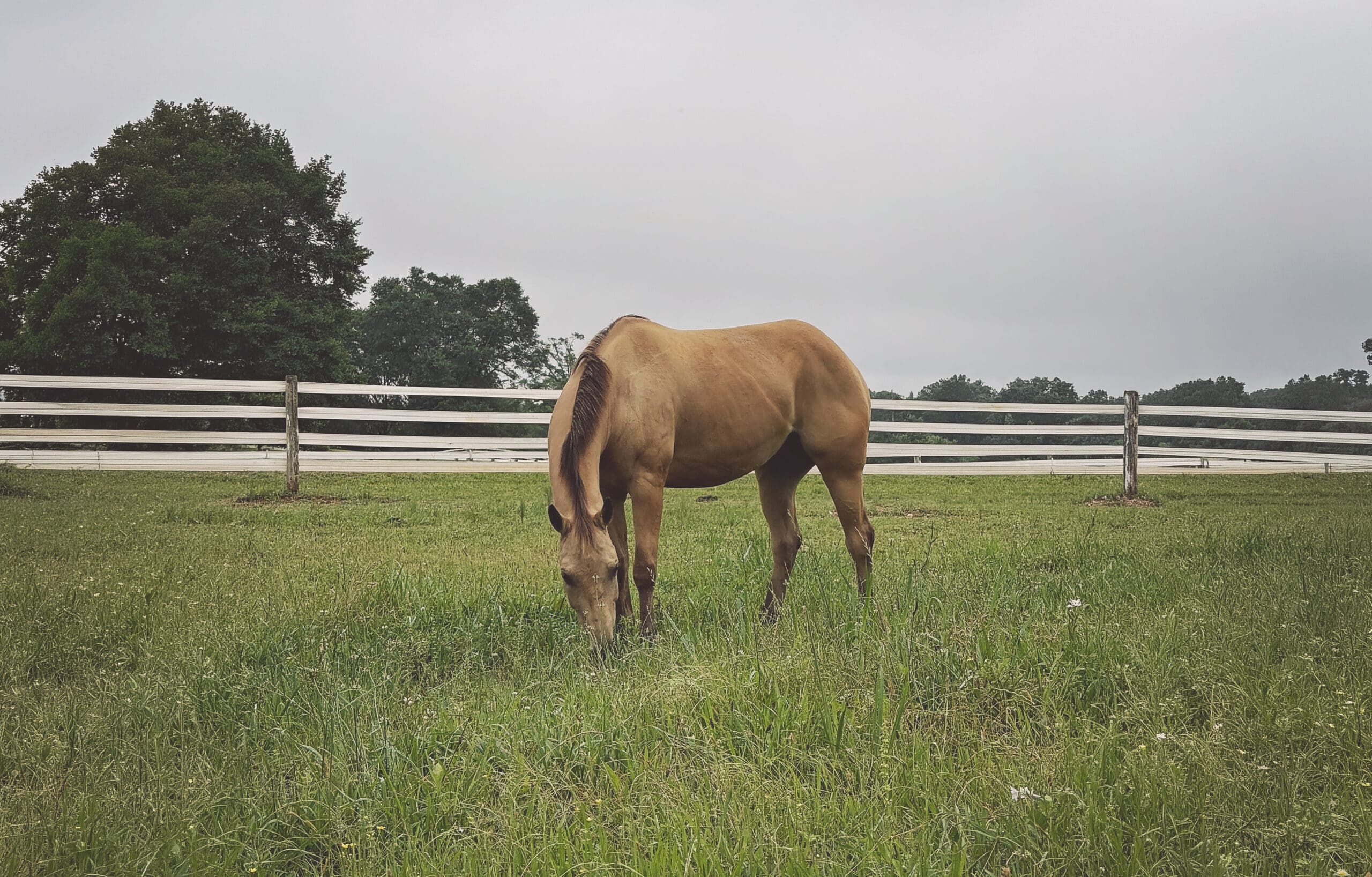
It was the middle of a Georgia summer afternoon when one of the boarders’ mares went down in the field. She was older, and the pasture she was in didn’t have a lot of shade where she was lying. Several of us were at the barn that day, the manager included. I happened to be the one who noticed her first.
She was on her side, sweating, eyes dull in a way I didn’t like. We got her up (which takes a minute when a horse doesn’t want to stand) and walked her in slow. The manager and I started cold hosing her at the wash rack. I started with her chest because that’s where I’d been told to start, and we worked outward from there. The pinch test on her neck confirmed dehydration. We called her vet, who talked us through what to do and authorized a dose of bute when we got there. By evening she was eating, drinking on her own, and acting like nothing had happened.
I’ll be honest with you: I’m still not sure if what we saw that afternoon was technically colic or heat exhaustion or both. The line between them isn’t always clean, and severe dehydration can absolutely trigger colic in a horse who isn’t already colicking. What I do know is that recognizing something was wrong, and recognizing it fast, was the difference between a scary afternoon and a much worse one. That is what this article is about.
What Colic Actually Is
Colic is not a disease. It’s a symptom, a catch-all term for abdominal pain in a horse, which can come from dozens of different causes ranging from mild (gas, a temporary obstruction) to life-threatening (a twisted gut, a severe impaction). The American Association of Equine Practitioners (AAEP) classifies it into three broad groups: intestinal dysfunctions (gas distention, impactions, spasms), intestinal accidents (displacements, torsions, hernias), and enteritis or ulcerations1.
The numbers are sobering. Colic is the number one killer of horses in the United States. The AAEP reports that it accounts for roughly 10 percent of all equine deaths2. A landmark study by Tinker et al. found that 28 percent of all horse deaths in the study population were attributable to colic, which was the highest proportional mortality rate of any cause of death3. The USDA’s National Animal Health Monitoring System has estimated annual colic incidence at approximately 4.2 cases per 100 horses⁴, while farm-based prospective studies have found rates as high as 10.6 cases per 100 horses per year⁵.
What that means in plain English: colic happens often, it kills horses regularly, and your job as an amateur is not to diagnose it. Your job is to notice it and to call the people who can.
Signs of Colic in Horses
Horses are, as a species, remarkably bad at telling you when they hurt. They evolved to hide weakness because weakness gets you eaten. By the time a horse is showing obvious distress, the situation has usually been building for a while. The signs below range from subtle to unmistakable. Your job is to learn to spot the subtle ones.
PAWING THE GROUND.
Repeated, restless, with no obvious cause. This is often one of the earliest signs.
WATCHING OR BITING AT THE FLANK.
A horse turning to look at her own belly, or actively nipping at her side, is telling you something is happening inside her.
ROLLING, OR TRYING TO.
Especially repeatedly, or with violence. Some rolling is normal. A horse who drops to the ground over and over, or who rolls in a way that looks frantic, is not okay. The AAEP also lists lying on the back or sitting in a dog-like position as classic signs⁶.
LYING DOWN MORE THAN USUAL, OR IN UNUSUAL PLACES.
The mare in the field was down in a spot she never chose to lie down in. That detail told me something before I got close enough to see anything else.
OFF FEED.
A horse who skips a meal, especially one who normally inhales her grain, is a horse to watch closely. Hay refusal is even more telling.
NO MANURE, OR VERY DRY MANURE.
A clean stall the next morning when there should be piles is a red flag. So is manure that looks dehydrated or unusually small.
SWEATING WITHOUT EXERTION.
A horse who is sweaty in the stall, or out in the field on a day that doesn’t warrant it, is in distress.
ELEVATED HEART RATE OR RESPIRATION.
A normal adult horse’s resting heart rate is roughly 28 to 44 beats per minute⁷. Anything over 50 BPM in a resting horse is a sign of distress. Over 80 BPM is a life-threatening crisis. Equally telling: silent gut sounds. If you put your ear to the flank and hear nothing, call your vet.
THE “SOMETHING’S WRONG” FEELING.
This is not on most clinical lists, but every experienced horseperson knows it. If you walk into the barn and something feels off about your horse, her expression, her posture, the way she’s standing, pay attention. Your gut is not nothing.
What to Do When You Suspect Colic
The moment you suspect colic, here is the order of operations:
1. Get the horse up if she is down. If she’s safe to approach and not thrashing, get a halter on her and get her standing. A horse who is down and rolling can twist a gut that wasn’t twisted before.
2. Remove feed and hay. Take it away. If she’s in a field with grass, get her out. The last thing a compromised digestive system needs is more to process. According to current AAEP guidance, you should also remove water until your vet evaluates the horse⁸.
3. Take her vitals if you can. Heart rate, respiration, temperature, gum color (should be pink and moist), capillary refill (press a thumb to her gum, color should return within two seconds). Write everything down. Your vet will ask.
4. Call the vet. Now. Not in twenty minutes when you see if it gets worse. Tell them what you’re seeing, what her vitals are, and how long she’s been showing signs. They will tell you whether to walk her, what to do until they arrive, and whether this is an emergency or a watch-and-wait.
5. Hand-walk only if your vet says to. Walking can help mild gas colics resolve. It can also exhaust a horse who needs to conserve energy for a surgical case. Follow your vet’s lead, not the internet’s.
Do not give bute, Banamine, or any other medication without your vet’s go-ahead. Pain medication can mask symptoms that your vet needs to see clearly when they arrive. Banamine in particular masks pain for up to twelve hours, which is more than enough time for a serious case to deteriorate undetected.
When to Call the Vet
Every time. There is no version of suspected colic where calling the vet is the wrong move. The worst case scenario is that you make a call you didn’t strictly need to make, and you and your vet have a brief conversation about what to watch for. The best case scenario is that you catch something early enough to matter. Vets would rather hear from you ten times for nothing than miss the one call that mattered. This is not the moment to be polite about their time.
Heat-related Colic in the Southeast
Summer in the South is its own particular risk profile. Heat stress, dehydration, and electrolyte imbalances are direct contributors to colic, and they happen faster than you think. Older horses, horses with compromised sweating (anhidrosis is more common down here than most people realize), and horses without consistent shade and water access are all at elevated risk. The mare in the field was probably a heat case first and a colic-risk case second, but the practical response was the same: cool her down, get fluids into the picture, call the vet, watch closely. Through the summer months, water access matters more than almost anything else. Check troughs daily. Confirm that automatic waterers are actually working. Watch for horses who aren’t drinking enough, and track output if you have to. Add electrolytes if your vet recommends them, particularly for horses in regular work.
Prevention Basics
Most colic cases are not preventable in any meaningful sense. Horses colic, and sometimes they colic for reasons nobody fully understands. The AAEP’s prevention guidelines focus on the foundations⁹: establish a daily routine and stick to it, feed a high-quality diet built primarily on roughage, provide constant access to clean fresh water, allow regular turnout and exercise, maintain a consistent parasite control program with your vet, and schedule annual dental care. None of these guarantee anything. All of them help.
The amateur horseperson does not need to be a veterinarian. She does not need to diagnose. She needs to notice the horse who isn’t right, notice the field that’s too quiet, notice the feeling that something is off. And then call the people who can help.
That noticing is the job.
Modern Amateur Magazine is not a substitute for veterinary care. If you suspect your horse is colicking, call your vet immediately.
1 American Association of Equine Practitioners. “Can You Prevent Colic?” aaep.org.
2American Association of Equine Practitioners. “10 Tips for Preventing Colic,” 2024. aaep.org.
3Tinker, M.K., et al. “Prospective study of equine colic incidence and mortality.” Equine Veterinary Journal, 1997, vol. 29, no. 6.
⁴ USDA APHIS National Animal Health Monitoring System. “Incidence of Colic in U.S. Horses,” NAHMS Equine ‘98.
⁵ Tinker, M.K., et al., 1997 (see above).
⁶ AAEP. “Can You Prevent Colic?” aaep.org.
⁷ Standard equine vital sign reference, commonly cited across veterinary literature.
⁸ AAEP. “10 Tips for Preventing Colic,” 2024. aaep.org.
⁹ AAEP. “10 Tips for Preventing Colic,” 2024. aaep.org.

