
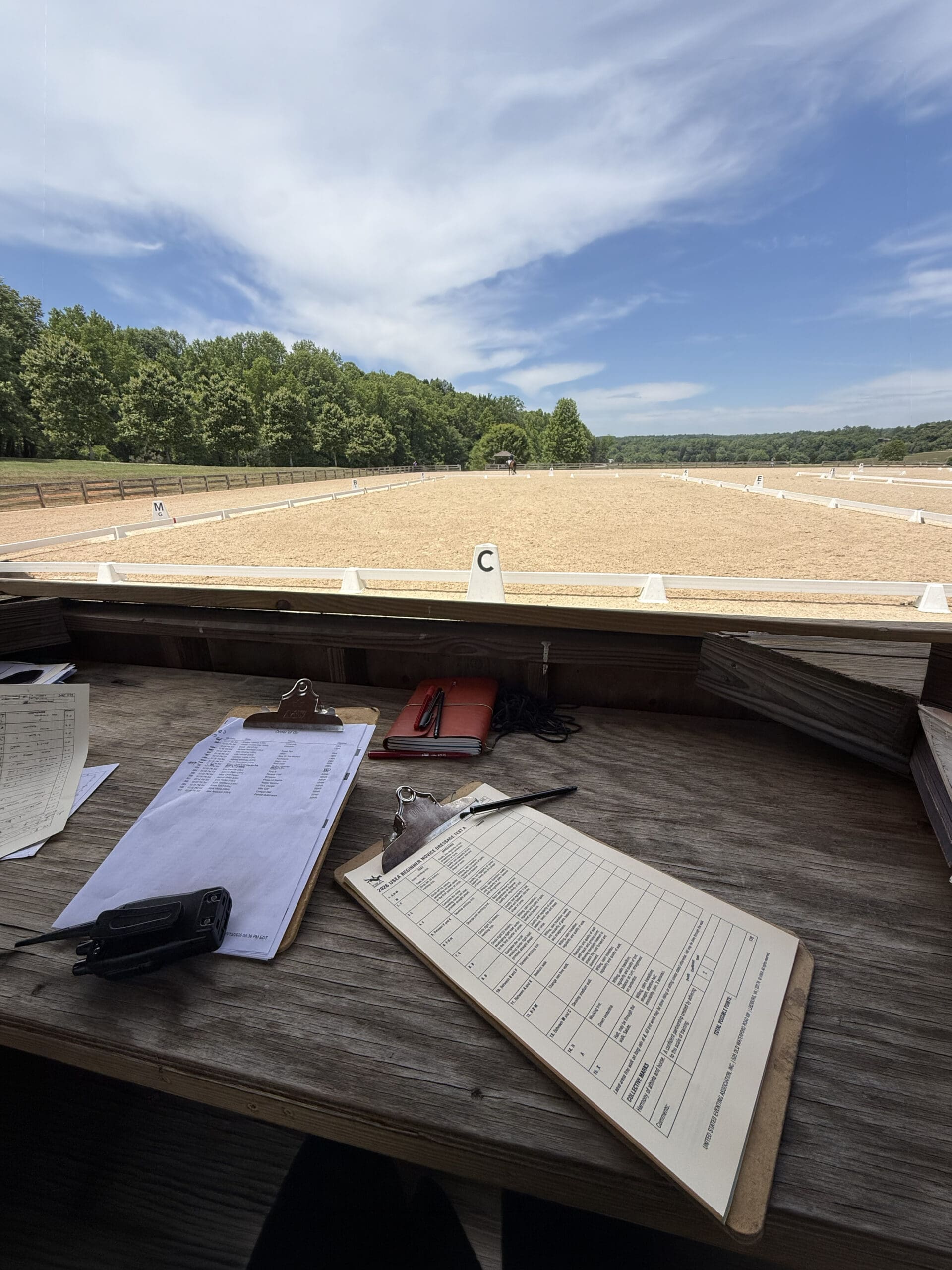
It was a surprisingly cool morning considering it was June in Georgia; nevertheless, my trusty ringside backpack was filled with all manner of things to keep me cool: fans, cooling towels, bottles of water, an extra hat…not to mention the other necessities to keep me as comfortable as possible throughout the day (sunscreen and bug spray, anyone?)
I had signed up to volunteer at one of my local showing venues to help out wherever the show team decided to plug me in. I spent some time previously doing various things at my local schooling shows to give back to the community and help support the other riders that I knew didn’t have the time to contribute themselves, but today was going to be different because today was level three Dressage, and as an aspiring eventer with a focus on dressage, today was especially exciting for me to watch.
I had been given the important job of scribing, which came complete with lots of written rules (black pen only, except when an error is made…you note that in red pen) and some unwritten rules (no talking to the judge unless they talk to you first). I had scribed before, but not at this level, and I was nervous; the tests were longer and more complex than I was used to, and no doubt the judge would be more serious and stern, so I would have to be on my A-game to faithfully record their comments so they could accurately score each rider.
As I sat in the booth at C getting my test sheets ready, I heard the wooden door open behind me and a gentle voice spoke, “Good morning.” He introduced himself as Brian MacMahon, an “R” Dressage/Western Dressage judge (USEF) and Bronze, Silver, and Gold USDF medalist. With over 35 years of experience, MacMahon has taken students from training level through the Grand Prix and operates clinics all over the southeast United States. Of course, I didn’t know this at the time, but MacMahon’s story slowly unfolded in-between dressage tests.
Write That Down, Write That Down!
The actual act of scribing was somewhat intense. Arriving at the show well before the first competitor came down center line to give their salute, I was tasked with heading to the volunteer office to grab a medium-sized tub full of all the things I could need: the tests, a clipboard, extra pens in both colors (black and red), a bell, an order-of-go, and, perhaps most importantly, the scribe guide (which I had admittedly already studied and memorized to make it easier on myself when I first started scribing at the beginning of the year). Nevertheless, I gave it a quick glance while I waited for the first horse and rider pair to enter the ring.
Dressage tests, apart from freestyles, are standardized and tend to be the same for a number of years (typically three) before they are updated–which meant that once a couple of riders had gone through, I started to learn the test (and more importantly anticipate what the judge might comment). Scribing isn’t difficult, but it can be nerve-racking: you have to watch the test while simultaneously recording the judge’s comments and scores. Sometimes they will change their mind about a score on a movement and ask for a correction, which leaves less time to record comments for the next movement. And yes, in this case, penmanship counts.
At the end of the test, the record gets passed to the judge, who records their final remarks, overall scores, and finally signs the test to “seal” it. Every so often a score runner would come by our booth and collect the completed tests so that the overall scoreboard could be updated, and anxious riders could comb through the comments to see what could be improved. Most venues I’d scribed for had been this well-oiled machine when it came to the administrative tasks; this particular venue was running ahead of schedule, which is a feat unto itself.
The Real Magic of Sharing Space with an Expert
While we waited in-between tests, MacMahon took the time to explain some of the finer points of what he looks for. I specifically asked about the free walk, which I had been struggling with on my OTTB. MacMahon responded that he always looks for a long, low, forward stretch through the neck in a free walk while maintaining a four-beat rhythm (which is where my own score was suffering). Ideally the horse needs to overtrack (meaning their hind hooves need to surpass the print made by the front hooves) in this gait, and contact needs to be maintained, not dropped entirely–which was another thing I had been doing incorrectly in my tests.
I also asked him to explain how he determines if the aids are effective or not; in short, effective aids garner an immediate response from the horse with very little visible effort from the rider (and no, dear reader, I am not at that level yet). Along with this effectiveness comes the horse’s ability to maintain balance and rhythm on their own; staying “in front of the leg” (meaning, on the haunches and off the forehand) makes everything easier for both horse and rider, but it is harder to maintain if either (or both) are unfit. Or, in my case, a little scared–my mount at the time was over seventeen hands but had what I liked to refer to as a “dinky” trot; several of my own dressage tests have comments like, “big horse. He has to GO somewhere!”
The conversation rolled around to more difficult movements, as the level three tests we were watching required them. Straightness was a big deal in these tests but so was bend, and timing them was trickier than it looked. Half passes in particular tended to be detractors; a lack of straightness before showing the half pass always got a lower score. That made sense to me: showing that you can be straight and you can bend in the same movement is far more impressive than coming in on a bend and maintaining it. The longer I listened to the comments on each movement, the more I realized that I was sitting next to someone who had as many years of experience as I had been alive, and that someone was worth listening to.
I was sitting next to someone who had as many years of experience as I had been alive, and that someone was worth listening to.
Two Is Better Than One
Towards the midpoint of our day my hands were starting to ache, so I sat down at the lunch table and listened to MacMahon chat with the other dressage judge for the day, his colleague Debby Savage. Savage, a USEF “S” dressage judge and an accomplished rider in her own right (and Region 2 Director of the USDF, besides), began as a western rider before eventually moving on to Eventing, and then finally Dressage–a background very similar to my own.
Listening to this conversation gave me more to think about beyond the obvious parts of showing as a dressage rider, which up to that point had mostly been me agonizing over every detail of my tests. Savage remarked on some of the turnout choices of the competitors (several had had their horses braided, which wasn’t a requirement at this stage) before moving on to ruminating on the conformation of some of the horses that she thought had more quality movements (Savage also has her Young Horse certification, acquired in Germany at the World Young Horse Championships). Having proper conformation and a well-built shoulder, she said, made all the difference in quality of the gaits regardless of the training level.
Savage also mentioned that quality of the gaits is the primary thing she looks for, because it doesn’t really vary from level to level; a good trot is a good trot whether you’re at training level or Prix St. George. Higher up the levels, the other primary factor is collection: how well the horse works as a whole from rear to front, achieving a more uphill, balanced carriage. It’s more than getting (and keeping) the horse on the bit; it’s keeping them off the forehand and encouraging suppleness, agility, and self carriage…and it gets more and more difficult the higher up the levels you go.
X, Halt, Salute
As the day drew to a close, my carpal tunnel was imminent and my brain was buzzing with all kinds of ideas to work with my own horse on some of the things I had learned (“impulsion” is a word I hear constantly in the back of my mind regardless of discipline). In one of the final tests, I watched a rider execute a lovely series of movements. She prepared her horse for the shoulder in by ever-so-slightly pressing her inside leg into the girth in a gentle bend, supporting with her outside leg just behind the girth to encourage the bend. A gentle flex of the hand on the inside rein produced a lovely shoulder in that naturally flowed into a well-supported, tracked-up trot on the circle before heading back to H in a half pass, gently encouraging flexion towards the end of the movement. They trotted on. I held my breath. It was perfect.
All of the tiny little things we had talked about throughout the day (balance, timing of the aids, and having a clear difference between straightness and bend) came together and harmonized in my mind. That pair got excellent marks and I was proud of myself for accurately predicting that MacMahon would consider those movements well-executed.
Throughout my time as a scribe I had invaluable access to two people at the height of the sport and they were not only willing to share their thoughts and knowledge, but were enthusiastic about it. That’s when it hit me: once a horse person, always a horse person. They’re really just like us amateurs: they love horses, they love doing cool things with their horses, and they love to chat about what they’re doing and trying with anyone and everyone who would listen. I had my homework (trying to get my OTTB to move his feet just a little more) and I had my notes (and the pain in my wrist to prove it), but I had something else: a genuine enthusiasm for the sport I had fallen in love with.

BLAIR BUSH is the founder and editor-in-chief of Modern Amateur Magazine. A lifelong horse person with a roundabout path to get here, she grew up riding gaited horses, stepped away from the sport for nearly two decades, and returned at 32 with something to prove. A brief detour through the hunter ring eventually led her to eventing, where she found her people. She is currently focused on dressage and working toward her USDF Bronze medal — which, she will tell you, is a five-year plan and not a suggestion. She is based in Atlanta, Georgia.

